

35 Day
WavWatch Stress Phase II
| STUDY TITLE | WavWatch Stress Phase II |
|---|---|
| Submitted under umbrella |
|
| Date submitted |
— |
| End date |
There is no pre-specified end date and sub-studies remain open long-term. |
| Language |
English |
| Efforia AI IRB approval recommendation |
— |
| Recruitment page preview | |
| Informed consent | |
| Study author |
John Bamber, Joseph Bamber, Linda Bamber, Matthew Amsden |
| Principal investigator |
Matthew Amsden |
| Sub-Investigator for Adverse Events |
Dr. Viral Patel |
| Description |
A 35-day single-arm study evaluating whether regular use of WAVwatch is associated with changes in perceived stress. Participants complete a 7-day untreated baseline run-in, then use the WAVwatch Stress & Relief Program daily for 28 days. The study is intentionally designed to reduce participant burden: validated stress and anxiety assessments are concentrated at baseline and study end, while the daily experience is limited to a very brief check-in. WAVwatch may help, have no measurable effect, or be associated with worse outcomes. |
| Participant engagement length |
35 Days |
| Sponsor |
This study is made possible by your payment to cover all supplies and expenses required to participate. |
| Cost to participant |
$597 |
| Included products & services |
WAVwatch 2.2 Preorder: $697
|
| Outcome measures |
Perceived Stress Scale (Past Week Version) General Anxiety Disorder (GAD-7) |
| Methodology |
Single Arm longitudinal where participants act as their own control |
| Basic or advanced dissemination plan |
Basic |
| Deviation from recruitment approach |
No |
| Deviation from statistical approach |
No |
| Will study include “more about you questions” |
No |
| ClinicalTrials.gov |
Yes |
| Commitment to list findings on ClinicalTrials.gov |
Yes |

 Preview
This document is prepared with the assistance of AI, but is reviewed by a human.
Rational & Study Design
The Intervention
Included Products & Services
Product Name: WAVwatch 2.2 Preorder
Quantity included: 1
Price: $697.00
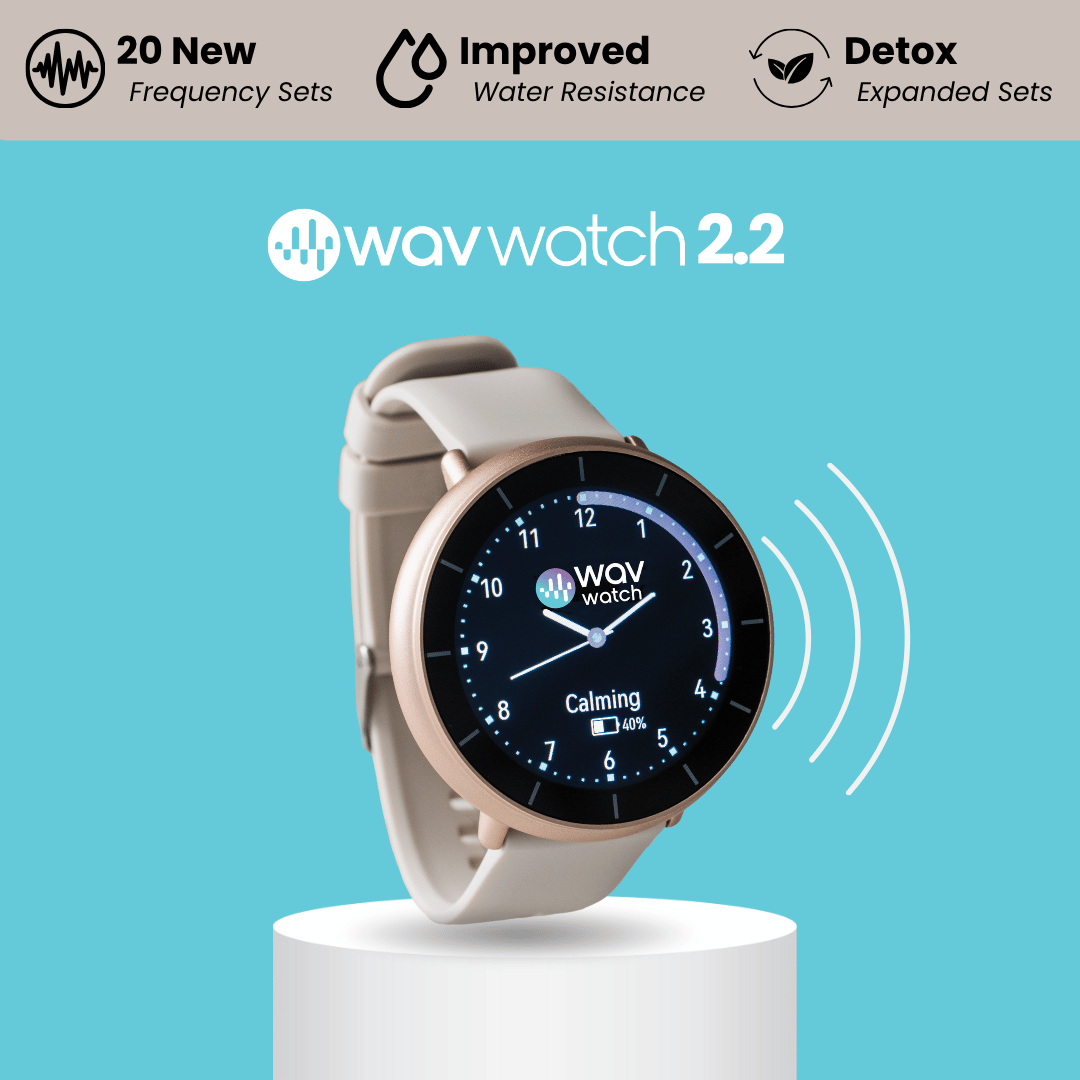
Product Description: WAVwatch 2.2 is here! Due to extremely high demand, our first batch of Rose Gold pre-orders are now sold out. New Rose Gold orders will not ship until January. Pay in full now to reserve yours in advance. Get more personalized wellness possibilities than ever before! ✓ 20 New Frequency Sets✓ Improved durability & water resistance ✓ Up to 18 hour battery life ✓ No WiFi, Bluetooth, or EMFs! WAVwatch 2.2 delivers a major upgrade from 2.0 — expanding from 146 to 166 Frequency Sets, adding brand-new programs for energy, detox, brain clarity, sleep, men’s and women’s health, and overall daily wellness. WAVwatch 2.2 includes the completely new Good Energy folder, enhanced WAVdetox options, a dedicated Vagus Nerve program, and redesigned Men’s and Women’s Health sets that replace the old “Reproductive Wellness” program with more targeted, effective support. All original 2.0 frequencies remain, but 2.2 organizes them more intuitively, adds 20 powerful new options, and features improved durability and water resistance. In short.
Product Image:
Ingredients:
Product Safety: rose gold
Study Design & Methodology
Inappropriate Participants & Inclusion/Exclusion
Include: adults age 18 or older who can use WAVwatch as directed, complete remote study activities, and are willing to maintain a reasonably stable stress-management routine during the 35-day study.
Do not participate or seek individualized clinical guidance first if: you are experiencing a severe or unstable mental health condition or acute mental health crisis; you have a history of seizures triggered by sound; you have significant sound sensitivity or a device/material sensitivity that may make use inappropriate; you are pregnant or nursing and are uncomfortable participating given the limited evidence base; or you anticipate starting or stopping a major medication, therapy, supplement, or other stress-directed intervention during the study period.
Participants with stable, treated anxiety are not automatically excluded, but existing treatments should remain stable when possible and material changes should be reported.
Study Design & Experience
Design: prospective single-arm within-person study with a 7-day untreated run-in followed by 28 days of standardized WAVwatch use.
Participant burden: one short daily check-in during baseline and treatment; PSS and GAD-7 only at the end of baseline and the end of treatment.
Primary estimand: mean within-person change in PSS score from baseline to final follow-up among participants with paired data.
Supportive analysis: change in daily stress from the untreated run-in to treatment and exploratory association between adherence/exposure and change in stress.
Statistical Analysis Plan
Primary endpoint: within-participant change in Perceived Stress Scale (Past Week Version) score from the Day 7 baseline assessment to the final assessment after 28 treatment days.
Primary analysis: paired t-test with mean change, 95% confidence interval, and within-person standardized effect size (Cohen's d_z). A Wilcoxon signed-rank analysis will be reported as a sensitivity analysis if the change-score distribution is materially non-normal or contains influential outliers.
Secondary endpoint: paired change in GAD-7 over the same interval, analyzed descriptively and with the same paired framework. Secondary findings will be labeled secondary and interpreted cautiously rather than treated as independent confirmatory claims.
Supportive longitudinal analysis: once the daily 0-10 check-in form is configured, daily stress will be summarized during the 7-day untreated run-in and 28-day treatment period. Analyses may compare each participant's mean baseline daily stress with treatment-period stress and may use a mixed-effects longitudinal model with participant-level random intercepts to estimate change over time. Daily WAVwatch completion and minutes used will be summarized as adherence measures and explored as modifiers of response.
Expectancy: baseline expectations will be summarized and explored as a covariate/sensitivity variable because endpoints are subjective and the study is unblinded.
Missing data: the primary paired analysis requires both baseline and final PSS data. Missingness, attrition, and adherence will be reported transparently. No last-observation-carried-forward imputation is planned for the primary analysis.
Sample size: target enrollment 55-60 participants to obtain approximately 40 evaluable paired completers. Forty paired completers provides approximately 80% power to detect a within-person standardized effect near d=0.45 at a two-sided alpha of 0.05.
Limitations & Justification
This remains an unblinded single-arm study, so causal attribution is limited by expectancy, secular changes, regression to the mean, and co-interventions. The untreated run-in improves characterization of each participant's pre-treatment trajectory but is not equivalent to a randomized control group. Subjective outcomes may be influenced by participants' beliefs about WAVwatch, which is why expectations are measured prospectively. Adherence is largely self-reported. Positive findings should be considered a stronger signal for a subsequent randomized or otherwise controlled study rather than definitive proof of efficacy.
Human Subjects Ethics
Suitability Under Minimal Risk Umbrella Protocol
Suitability for Pay to Participate Model
Human Subjects Protection Questionnaire
Beneficence: The study has a defined primary question, uses validated outcome measures, and improves interpretability over the prior single-arm design by adding an untreated run-in.
Non-maleficence: The intervention is non-invasive; participants are instructed to stop and seek care for concerning symptoms. Eligibility language is intended to exclude participants for whom the device or study procedures may be inappropriate.
Autonomy: Consent uses neutral language and explicitly states that benefit is uncertain. Participation is voluntary and participants may withdraw.
Justice: Enrollment criteria are tied to the research question and safety rather than demographic characteristics unrelated to the study.